The Situation
Aisha Al-Rashid's fashion brand was growing quickly in the UAE, which created a problem nobody had planned for. Customer enquiries through WhatsApp were accelerating faster than the support team could handle them. At peak, they were receiving 300–400 messages a day: order tracking, return requests, sizing questions, complaints, payment queries.
The team was responding manually to all of it. Response times averaged four hours during the day and often stretched to the next morning for evening messages. Customer satisfaction was slipping. Staff were exhausted. Hiring more support agents was on the table, but at AED 8,000–12,000 per head per month, it wasn't a cheap solution to a problem that would only keep growing.
The real problem wasn't volume. It was that 80% of the messages were asking the same 12 questions.
The message audit
We spent the first week reviewing 30 days of incoming WhatsApp conversations and categorising every message by type. The breakdown was revealing:
Order status / tracking enquiries
Return and exchange requests
Sizing and availability questions
Payment and invoice queries
Delivery timing (UAE + international)
Complex queries requiring human handling
That 20% was the only category that actually needed a human. Everything else was answerable with the right data and the right automation logic.
The Strategy
Most automation projects fail because they try to automate everything at once and end up with brittle systems that frustrate customers. Starting with a clear breakdown of what was actually coming in let us design something narrower and more disciplined: automate the 80% that followed predictable patterns, and keep humans firmly in the loop for the 20% that genuinely needed judgment.
Critically, every automated message had to match the brand's existing tone of voice. Customers interacting with the system weren't meant to feel like they'd hit a bot. We spent time getting that right before anything went live. That tone-of-voice work was as important as the automation logic itself.
The Build
We designed and built an automated WhatsApp system using the WhatsApp Business API, connected to the brand's order management platform and CRM via Make.com. The system handled:
Order status lookup and tracking link delivery, triggered automatically when customers asked about their order.
A structured return flow that collected the required information, logged it in the CRM, and confirmed the process to the customer.
Dynamic sizing guide delivery, sent based on product category.
Invoice resend and payment status lookups, connected to their billing system.
An intelligent routing system that acknowledged messages at any hour and set clear expectations for human follow-up where needed.
The remaining 20% of messages (complaints, unusual situations, VIP customers) were automatically flagged for human review and routed to the appropriate team member with context attached.
What Made the Difference
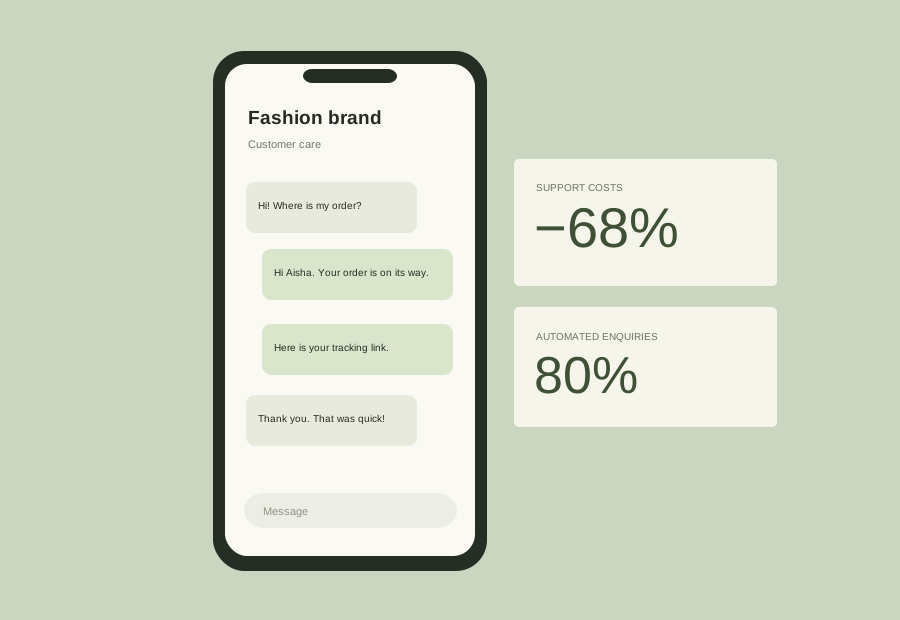
Within the first month of going live, 80% of incoming messages were being handled entirely by the automation. Response time for automated replies dropped to under 8 minutes. The support team, instead of drowning in repetitive queries, was dealing exclusively with the messages that actually required human judgment.
Support operating costs dropped 68%. The team went from five people on WhatsApp duty to two. The other three were redeployed to higher-value work. No redundancies, just better allocation.
"We were handling 300+ customer messages a day manually. The WhatsApp automation Pexovia built now handles 80% of them without any team input. Our support costs dropped 68% and response time went from hours to minutes. Our team finally has time to focus on actual problems."
The message audit was the foundation. Most automation projects fail because they try to automate everything at once. Starting with a clear breakdown of what was actually coming in allowed us to build something that handled the 80% perfectly while keeping humans firmly in the loop for the 20% that mattered.
The lesson: the automation itself was never the hard part. Knowing exactly what to automate and what to deliberately leave to a person was.